
Visibility is no longer contained within search results, social feeds, paid placements or PR coverage.
It is becoming one connected system.
Brands are not simply competing to rank. They are competing to be understood, cited, recognised, recommended and remembered across search engines, AI assistants, social platforms, media coverage and professional networks.
Several developments during June reinforced this direction. Google increased the pressure on low-value content. AI search performance began moving towards clearer measurement. Social platforms invested further in answer-led discovery. Advertising started following users into AI-generated experiences.
Taken separately, these might look like platform updates, but together, they point to a more fundamental change in how organisations become visible.
Search, SEO, AEO & GEO
Search visibility is becoming less about volume and more about whether content is genuinely useful, specific and trustworthy
Google’s June Spam Update has once again placed low-value, scaled and overly automated content under greater scrutiny.
This isn’t a new rule; Google has consistently said that automation becomes a problem when it is used primarily to manipulate rankings rather than help an audience. What has changed is the volume of generic AI-assisted content now competing for attention.
Simply producing more articles isn’t a strong strategy, brands need original expertise, credible evidence and a clear reason for each piece of content to exist.
Before publishing, teams should ask:
- Does this add something specific?
- Does it demonstrate genuine experience or analysis?
- Would somebody trust it enough to reference it?
- Would we be comfortable attaching an expert’s name to it?

AI visibility is becoming easier to measure
Until recently, marketers had limited insight into whether their content was appearing within AI-powered search experiences. Google has now begun introducing more specific Search Console reporting around generative search visibility, including appearances within AI Overviews.
The rollout is gradual, but the direction matters.
AI search is beginning to move towards a measurable part of digital performance, helping marketers understand which pages, topics and sources are being selected for AI-generated answers.
Google Business Profile Analytics can now be found in GA4
Google has documented a native link between Google Business Profile and Google Analytics, bringing local metrics like calls and directions into GA reports.
Once a profile is linked, a Google Business Profile section appears in your reports. It includes seven metrics: interactions, website clicks, calls, directions, messages, bookings, and menus.
Why does this matter? The update will be instrumental in helping local businesses better connect profile activity with conversions.
Advertising
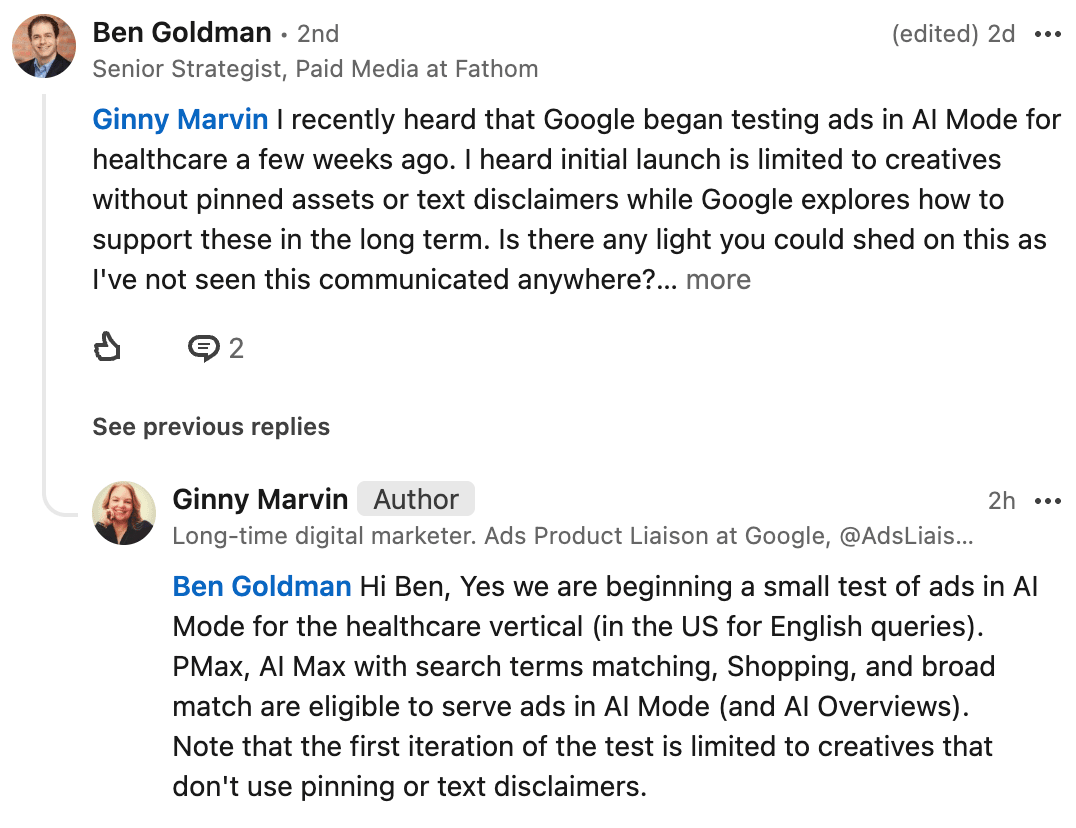
Google begins to test healthcare ads within AI Mode, as part of a US-based pilot
Healthcare has historically been excluded from AI search ads because of its regulatory complexity. However, if Google is confident enough to test ads here, it’s a strong signal that other regulated sectors, and eventually all industries could see broader AI advertising options.
The takeaway? It’s another step towards AI search becoming a fully monetised channel.
Brands should see it as an early signal of where Google Ads is heading, with AI search set to become an increasingly important part of both paid and organic search strategies.
Meta’s new UK-based ‘2% location fee’ will come into effect on the 1st of July
Meta is introducing embedded appointment bookings within Facebook lead ads, reducing the number of steps between seeing an advert and making a booking.
This is another example of platforms trying to contain more of the customer journey. The fewer clicks required, the lower the opportunity for users to abandon the process. For appointment-led organisations, this could improve conversion rates.
It also means marketers will need to think more carefully about the experience that takes place within the platform, rather than concentrating only on the landing page.
At the same time, Meta’s new 2% UK location fee will increase the cost of reaching UK users from 1 July.
The percentage may look small, but across significant annual budgets, it will not be. There are some steps you can take to prepare: Review your budget forecasts, update your reporting, check your targeting settings, reassess your cross-platform strategy.
AI search is becoming an advertising channel
OpenAI’s UK launch of ChatGPT Ads Manager gives advertisers an early chance to learn and prepare for a potentially major new ad channel.
OpenAI has begun rolling out Ads Manager Beta to businesses in the UK, according to an email sent to advertisers announcing availability of the platform. For agencies. OpenAI is advising agencies and freelancers not to create accounts on behalf of clients.
Instead, clients should:
- Create their own Ads Manager account.
- Navigate to Settings → Users → Invites.
- Invite agency partners with appropriate permission levels.
Access to Ads Manager gives UK brands and agencies the opportunity to understand the interface, workflows, and account structure before broader adoption begins.
PR
Brand recognition still matters
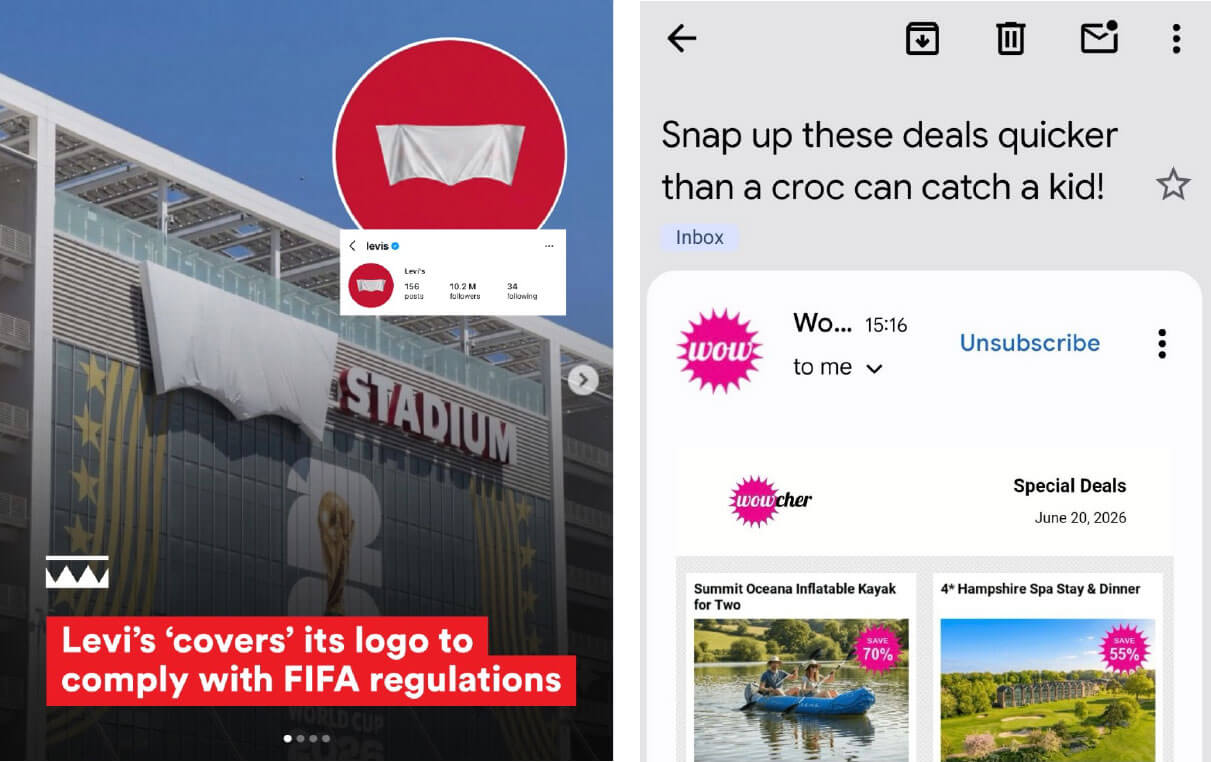
One of June’s strongest PR examples came from Levi’s.
When required to obscure its logo because of World Cup branding rules, the company covered the name while leaving the recognisable shape of the branding visible.
People still knew exactly which company was involved; that’s the value of distinctive brand assets.
A strong brand should not need to explain itself every time it appears. Colours, shapes, language, visual devices and familiar behaviours all help create recognition, and performance marketing can generate an immediate action.
Governance matters just as much as creativity
On the flip side, Wowcher’s public apology following an offensive marketing email offers the less comfortable lesson from June.
A campaign mistake can move from an inbox to national coverage very quickly; an unacceptable email sent from Wowchers team was unforgivable for customers on their mailing list. Reacting to the email, one customer said they had “now unsubscribed” from Wowcher’s emails, while another person condemned the message as “disgusting”.
Approval processes, editorial judgement and crisis planning are therefore not administrative extras. They are part of protecting the value of the brand.
Whilst reactive speed is useful in marketing, publishing something quickly that damages trust is not.
AI
Google’s guidance on AI-generated content still centres on human accountability and editorial rigour
Following on from the search news above, Google’s guidance specifically says that using automation to generate content with the primary purpose of manipulating search rankings violates its spam policies.
Human accountability and editorial rigour remain essential for SEO. What do we need to know? Before sharing an article, we should be asking:
- Does the article provide original content or information, original reporting, original research, or original analysis?
- Does it have the kind of quality you’d expect to see referenced by a magazine, encyclopedia, or book?
- Would you be comfortable giving this to your editor and putting your name on it?
The web increasingly has two audiences
The Economist is reportedly exploring a digital model that recognises two distinct audiences: people and AI agents.
- Human readers want clarity, usefulness and a reason to keep reading.
- AI systems need clear structure, unambiguous language, supporting evidence and identifiable expertise.
These needs are not in conflict; in most cases, content that is easier for an AI system to interpret is also easier for a busy person to understand.
The answer is not to create robotic content for machines, but to remove the ambiguity, filler and weak claims that make content less useful to everyone.
AI optimisation should therefore sit alongside SEO, editorial strategy and digital PR. It should not replace them.
Digital
The UK government announced plans to ban under-16s from using social media, with restrictions expected by early 2027
What does it mean for marketing agencies and their brands? Well certainty a shift in approach and a perhaps ‘not so sad’ farewell to children marketing to children under the guise of ‘influencers’.
To reach under-16s, brands that have previously targeted children directly on social media platforms will now have to rethink their strategies, perhaps creating content that appeals to parents and grandparents instead. A resurgence of spend on TV advertising during prime-time family viewing could be on the cards, and the creation of more all-encompassing multi-generational advertising.
Read more about what the social media ban means for brands and agencies.
Social Media
Social content is becoming searchable content
Meta’s introduction of an AI-led search experience on Facebook signals another move away from purely feed-based discovery.
Users can increasingly ask questions and receive answers based on public posts, recommendations and conversations across a platform. This means social content needs to do more than interrupt somebody while they scroll – it also needs to be understandable, searchable and useful enough to contribute to an answer.
The distinction between social content and search content is slowly disappearing.
Meta also announced new embedded appointment bookings for lead ads, which will integrate third-party booking platforms directly into the ad itself.
The update includes pre-filled fields within the booking form in order to streamline signup. Embedded appointment booking is being rolled out for Facebook ads only, with full global availability expected in October.
What does this mean for lead generation ads run on Meta? This should see more people signing up directly from Facebook ads, subsequently driving more direct response and bookings.
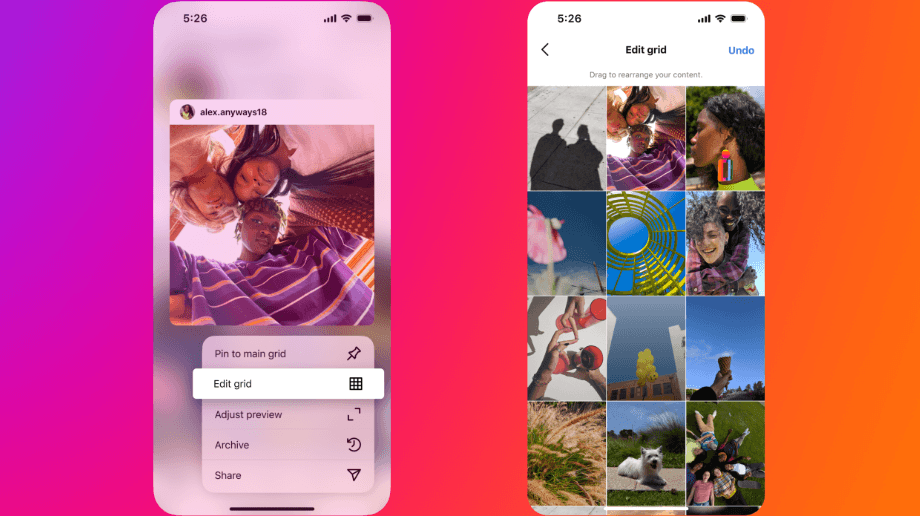
Instagram’s long-awaited feature has arrived!
You can now reorder your grid.
This gives brands more control over profile first impressions, helping them showcase priority campaigns, products and proof points more strategically. (Currently only available on the mobile Instagram app & not yet on desktop!)
Why does this matter? It means you can treat the grid like a landing page, not just a feed.
We’d recommend avoiding over-designing it. Clarity over aesthetic: a polished grid is nice to look at, but clarity matters more to your target consumer; current promotions and seasonal campaigns, key products/service offerings and testimonials should take the top spots on your grid.
People remain more powerful than pages
LinkedIn is rolling out collaborative posts, allowing users and company pages to co-author content.
For brands, this creates a stronger way to tap into employee, partner and creator networks, helping posts travel beyond the limits of a company page. Collaborative posts provide another means for brands to tap into the value of member networks, which generally drive more reach than company page posts.
For B2B organisations, this supports a broader strategic point. Brands should think more about how people, partners and pages can distribute content together and amplify post engagement. Employees, leaders, technical experts, clients and partners all have networks that can strengthen the credibility and reach of a message.
LinkedIn’s new in-network and out-of-network analytics should make this easier to assess.
In-network performance shows whether content is resonating with the audience a brand already has. Out-of-network reach shows whether it is travelling beyond that audience and introducing the organisation to new people.
Both matter, but they answer very different questions.
LinkedIn is also expanding testing of its dedicated vertical video feed, with users in the UK, Canada and Australia now seeing the feature again. LinkedIn first tested this feature in 2024, but its return suggests the platform remains committed to making video a core part of the experience despite mixed creator feedback on performance.
Reddit launches video replies
Reddit users have one more way to engage with each other, with video now available in the comments. This commenting feature expands upon the existing engagement options, which already include images, GIFs, and text.
Key takeaway: Reddit is increasingly valuable for product discovery and AI search visibility, because its public, human-led conversations are often used as source material across the web. Video replies add another content format for brands, creators and community hosts to answer questions, explain products and build credibility in relevant threads.
What changes for marketers?
The main lesson from June is not that every business needs more AI content, more video or another platform strategy.
It is that visibility is becoming more connected.
- A credible website can influence AI search.
- Expert PR coverage can support search authority.
- Useful social posts can become source material for AI-led discovery.
- Employees can distribute corporate messages through trusted personal networks.
- Distinctive brand assets can strengthen every channel in which they appear.
The organisations best placed to benefit will not necessarily be the ones producing the most content, they will be the ones building the clearest, most credible and most recognisable presence.
Share this